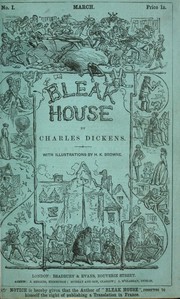
Bleak House
A sweeping satire of the British legal system centered on an interminable court case. One of Dickens' most complex and accomplished novels.
As an Amazon Associate, MyBookPDF earns from qualifying purchases. Bleak House is free to read and download here; the Amazon (print book) and Audible (free-trial audiobook) links are affiliate links and optional.
Download free (text, PDF, EPUB, Kindle)
Free, public domain, no registration. The plain text comes from this site; PDF, EPUB and Kindle files open on Project Gutenberg. Free audiobook: LibriVox.
More: Bleak House summary · books like Bleak House · more by Charles Dickens · browse the library.
Read the opening of Bleak House
London. Michaelmas term lately over, and the Lord Chancellor sitting in Lincoln’s Inn Hall. Implacable November weather. As much mud in the streets as if the waters had but newly retired from the face of the earth, and it would not be wonderful to meet a Megalosaurus, forty feet long or so, waddling like an elephantine lizard up Holborn Hill. Smoke lowering down from chimney-pots, making a soft black drizzle, with flakes of soot in it as big as full-grown snowflakes—gone into mourning, one might imagine, for the death of the sun. Dogs, undistinguishable in mire. Horses, scarcely better; splashed to their very blinkers. Foot passengers, jostling one another’s umbrellas in a general infection of ill temper, and losing their foot-hold at street-corners, where tens of thousands of other foot passengers have been slipping and sliding since the day broke (if this day ever broke), adding new deposits to the crust upon crust of mud, sticking at those points tenaciously to the pavement, and accumulating at compound interest.
Fog everywhere. Fog up the river, where it flows among green aits and meadows; fog down the river, where it rolls defiled among the tiers of shipping and the waterside pollutions of a great (and dirty) city. Fog on the Essex marshes, fog on the Kentish heights. Fog creeping into the cabooses of collier-brigs; fog lying out on the yards and hovering in the rigging of great ships; fog drooping on the gunwales of barges and small boats. Fog in the eyes and throats of ancient Greenwich pensioners, wheezing by the firesides of their wards; fog in the stem and bowl of the afternoon pipe of the wrathful skipper, down in his close cabin; fog cruelly pinching the toes and fingers of his shivering little ’prentice boy on deck. Chance people on the bridges peeping over the parapets into a nether sky of fog, with fog all round them, as if they were up in a balloon and hanging in the misty clouds.
Gas looming through the fog in divers places in the streets, much as the sun may, from the spongey fields, be seen to loom by husbandman and ploughboy. Most of the shops lighted two hours before their time—as the gas seems to know, for it has a haggard and unwilling look.
The raw afternoon is rawest, and the dense fog is densest, and the muddy streets are muddiest near that leaden-headed old obstruction, appropriate ornament for the threshold of a leaden-headed old corporation, Temple Bar. And hard by Temple Bar, in Lincoln’s Inn Hall, at the very heart of the fog, sits the Lord High Chancellor in his High Court of Chancery.
Never can there come fog too thick, never can there come mud and mire too deep, to assort with the groping and floundering condition which this High Court of Chancery, most pestilent of hoary sinners, holds this day in the sight of heaven and earth.
On such an afternoon, if ever, the Lord High Chancellor ought to be sitting here—as here he is—with a foggy glory round his head, softly fenced in with crimson cloth and curtains, addressed by a large advocate with great whiskers, a little voice, and an interminable brief, and outwardly directing his contemplation to the lantern in the roof, where he can see nothing but fog. On such an afternoon some score of members of the High Court of Chancery bar ought to be—as here they are—mistily engaged in one of the ten thousand stages of an endless cause, tripping one another up on slippery precedents, groping knee-deep in technicalities, running their goat-hair and horsehair warded heads against walls of words and making a pretence of equity with serious faces, as players might. On such an afternoon the various solicitors in the cause, some two or three of whom have inherited it from their fathers, who made a fortune by it, ought to be—as are they not?—ranged in a line, in a long matted well (but you might look in vain for truth at the bottom of it) between the registrar’s red table and the silk gowns, with bills, cross-bills, answers, rejoinders, injunctions, affidavits, issues, references to masters, masters’ reports, mountains of costly nonsense, piled before them. Well may the court be dim, with wasting candles here and there; well may the fog hang heavy in it, as if it would never get out; well may the stained-glass windows lose their colour and admit no light of day into the place; well may the uninitiated from the streets, who peep in through the glass panes in the door, be deterred from entrance by its owlish aspect and by the drawl, languidly echoing to the roof from the padded dais where the Lord High Chancellor looks into the lantern that has no light in it and where the attendant wigs are all stuck in a fog-bank! This is the Court of Chancery, which has its decaying houses and its blighted lands in every shire, which has its worn-out lunatic in every madhouse and its dead in every churchyard, which has its ruined suitor with his slipshod heels and threadbare dress borrowing and begging through the round of every man’s acquaintance, which gives to monied might the means abundantly of wearying out the right, which so exhausts finances, patience, courage, hope, so overthrows the brain and breaks the heart, that there is not an honourable man among its practitioners who would not give—who does not often give—the warning, “Suffer any wrong that can be done you rather than come here!”
The full book, free in your browser. No sign-up.